
Endoscopic Ultrasound

“Train echoendoscope handling while exploring digestive and biliary anatomy.”
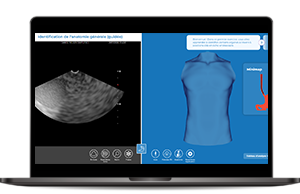
EUS

Endoscopic Ultrasound

In collaboration with

ihu

About the curriculum

What are the fundamentals of endoscopic ultrasound (EUS)?

How can the organs of interest be identified?

  • null

    7 clinical cases

  • null

    2 guided exercises

  • null

    Endoscopic ultrasound

  • Identify the 6 key positions of the endoscope within the digestive tract that are necessary for endoscopic ultrasound
  • Rotate and move the endoscope forward and backward
  • Find and identify the liver, the kidneys, the spleen, the gallbladder, the pancreas and the digestive tract 

  • Use endoscopic ultrasound to explore the following organs in more detail: pancreas, gallbladder, liver
  • Identify the different parts of each of these organs

  • Explore the biliary tract in details using endoscopic ultrasound: pancreatic ducts, gallbladder ducts, hepatic ducts
  • Identify the different parts of each of these ducts

  • Identify main hepatic veins and arteries using endoscopic ultrasound:
    • Vena cava 
    • Portal vein 
    • Superior mesentric vein and artery
    • Common, left and right hepatic arteries 
    • Common, left and right hepatic veins

  • Identify surrenals using endoscpic ultrasound
  • Identify renal vein and artery in both kidneys

  • Identify veins and arteries of spleen and stomach using endoscopic ultrasound:
    • Splenic vein and artery
    • Short gastric artery and vein 
    • Gastro omental artery and vein